Scroll

How Carbon Credits Work

Carbon credits are tradable certificates representing activities that reduce or remove greenhouse gas emissions (GHG) in Earth’s atmosphere. The Moovit Low Carbon Commute Project enables corporate carbon credit buyers the ability to purchase voluntary carbon credits that offset their corporate scope 1, 2 or 3 emissions while facilitating the funding of the decarbonization project and the enhancement of Moovit’s commuter app.

Get in Touch

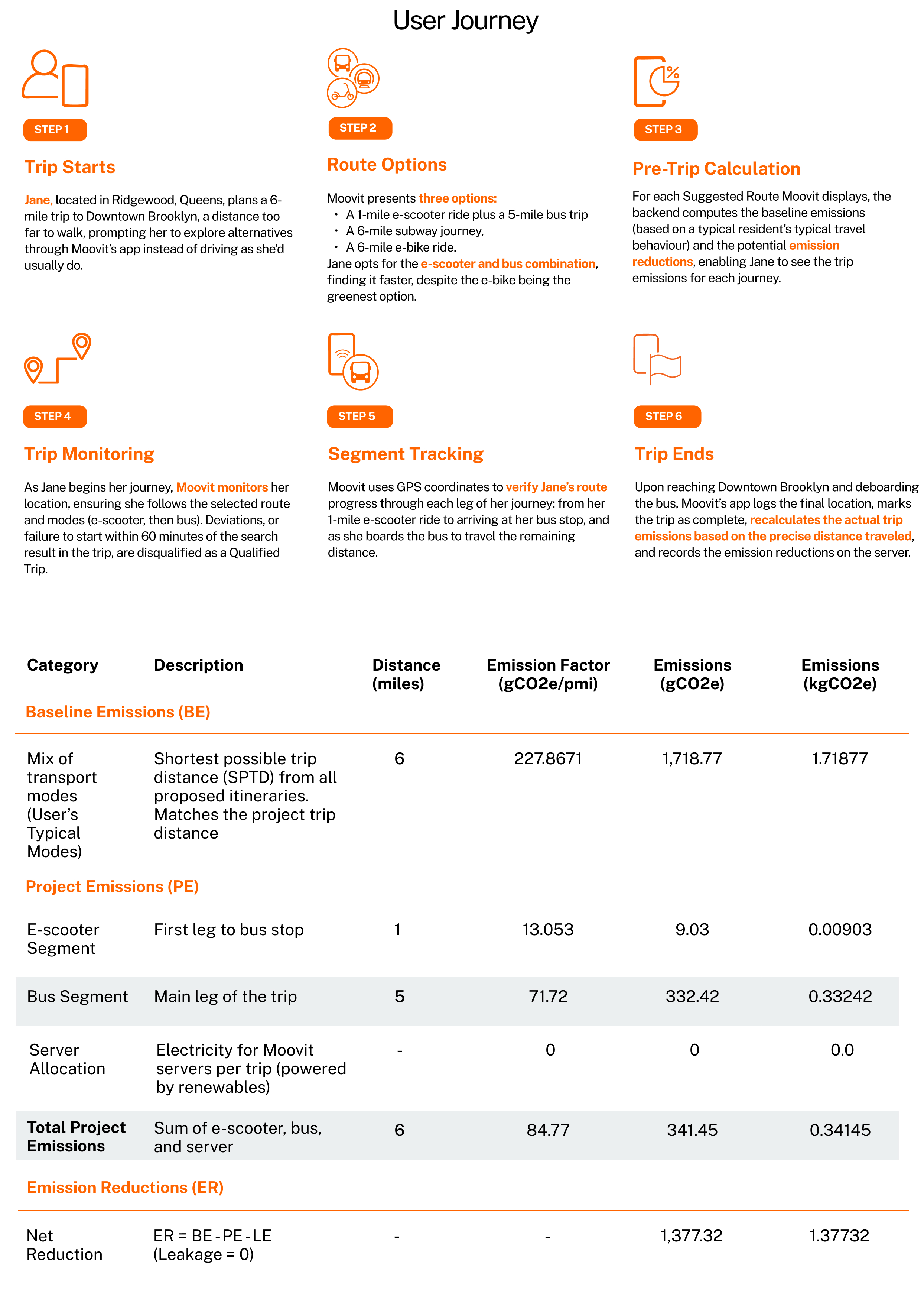
Example: Jane in NYC

Emission reductions are only eligible to generate carbon credits if the trip meets all decarbonization project criteria, including the registry’s terms and conditions, ensuring compliance with the project’s criteria.

Annually, Moovit aggregates emission reductions from thousands to millions of qualified trips, undergoes third-party verification by an independent audit company, and submits the results to the registry, which issues carbon credits at a rate of one carbon credit per metric tonne of CO2e reduced.

Reach Climate Goals with Moovit

The Moovit Low Carbon Commute Project aims to directly reduce the carbon intensity of urban travel by incentivizing shifts from high-carbon modes, such as internal combustion engine (ICE) vehicles, to lower-carbon modes, like public transit, bicycles, scooters, and ride-sharing. The resulting decrease in emissions produces high-integrity carbon credits for purchase from corporate buyers.

The program offers:

  • Real-time trip tracking within Moovit’s API
  • Data processing on Moovit’s servers for privacy
  • Periodic aggregation for third-party verification

Learn how Moovit’s Low Carbon Commute Program can benefit your business’ carbon goals.

Technology-based Carbon Credits

Moovit’s technology-driven approach delivers rapid, urban-focused results, and is adaptable to diverse regions. There is a direct link between user actions and verified emission reductions, which occur as trips happen, making our project an agile, high-integrity complement to traditional nature-based credits. Pilot programs* have shown that commuter apps can change user behavior, with one initiative reducing car use from 65% to 42% of modal share, with corresponding increases in cycling, walking, and public transit reliance.

*Casquero, et al, 2022. Casquero, D.; Monzon, A,; García, M.; Martínez, O. Key “Elements of Mobility Apps for Improving Urban Travel Patterns: A Literature Review”. Future Transportation 2022, 2, 1–23.

Contact Us

Discover how we can empower your business

Get in Touch